 KH Lab
Lab 3.1: Smooth Endoplasmic Reticulum, Spine Apparatus, and Endosomes
Overview
In this lab you look for smooth endoplasmic reticulum (SER), spine apparatus (SA), and endosomes in 5 additional spines, and stamp each one you find. Each Figure box links a journal figure from the papers listed under References; open them while you work. The EM screenshots on this page show examples from other spines of the series, not from your 5 assigned spines.
Smooth endoplasmic reticulum (SER)
- SER has a flattened, oval appearance surrounded by a membrane, but this shape can be variable (e.g., on one section the SER can look like a gray smudge, a small black dot, a snake-like black line, or a large vesicle-like lake).
- SER is connected across serial sections (though sometimes this continuity can be difficult to see).
Figure: snake-like tubule of SER entering a spine
Spacek & Harris, 1997, Fig. 2c. Open the paper.
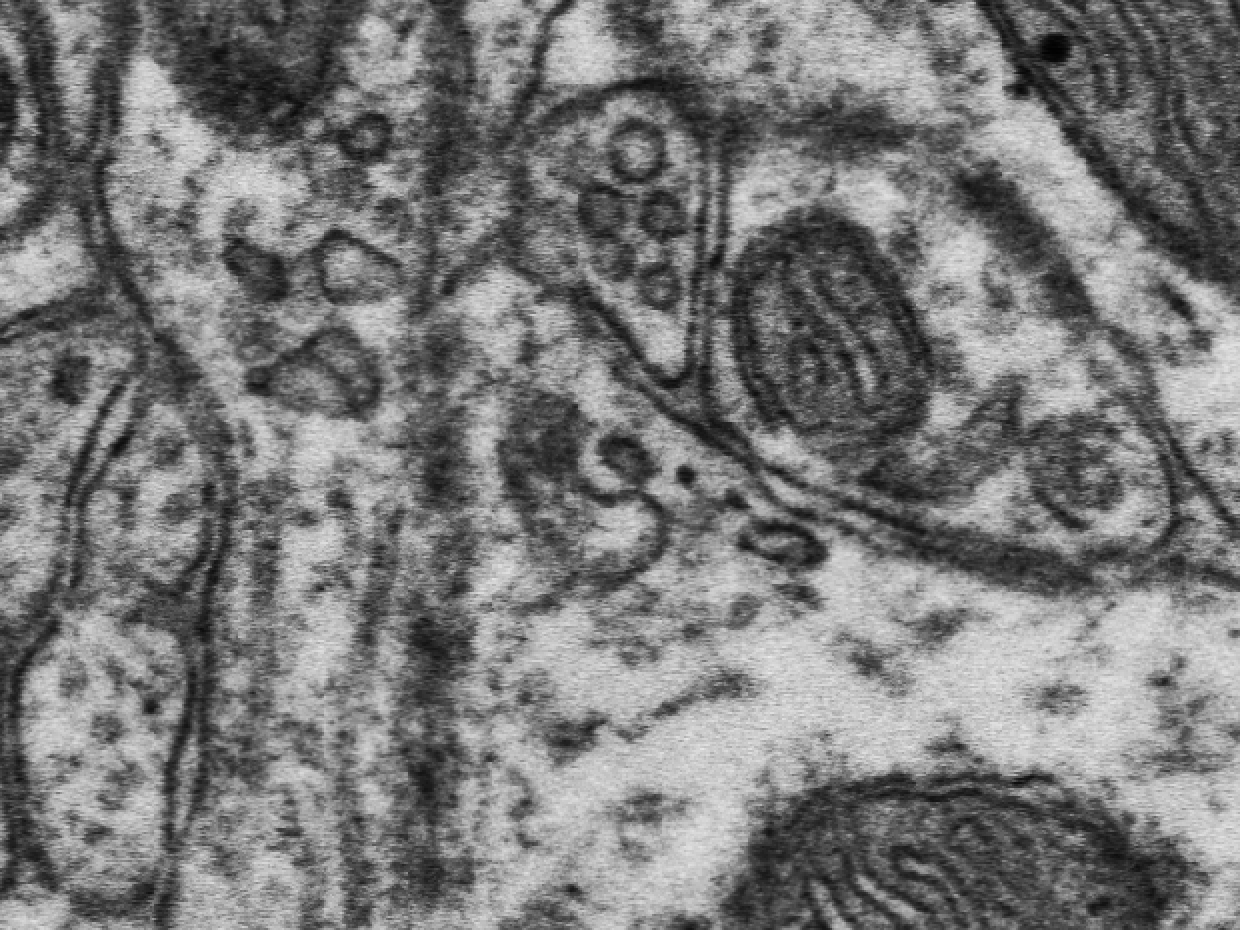
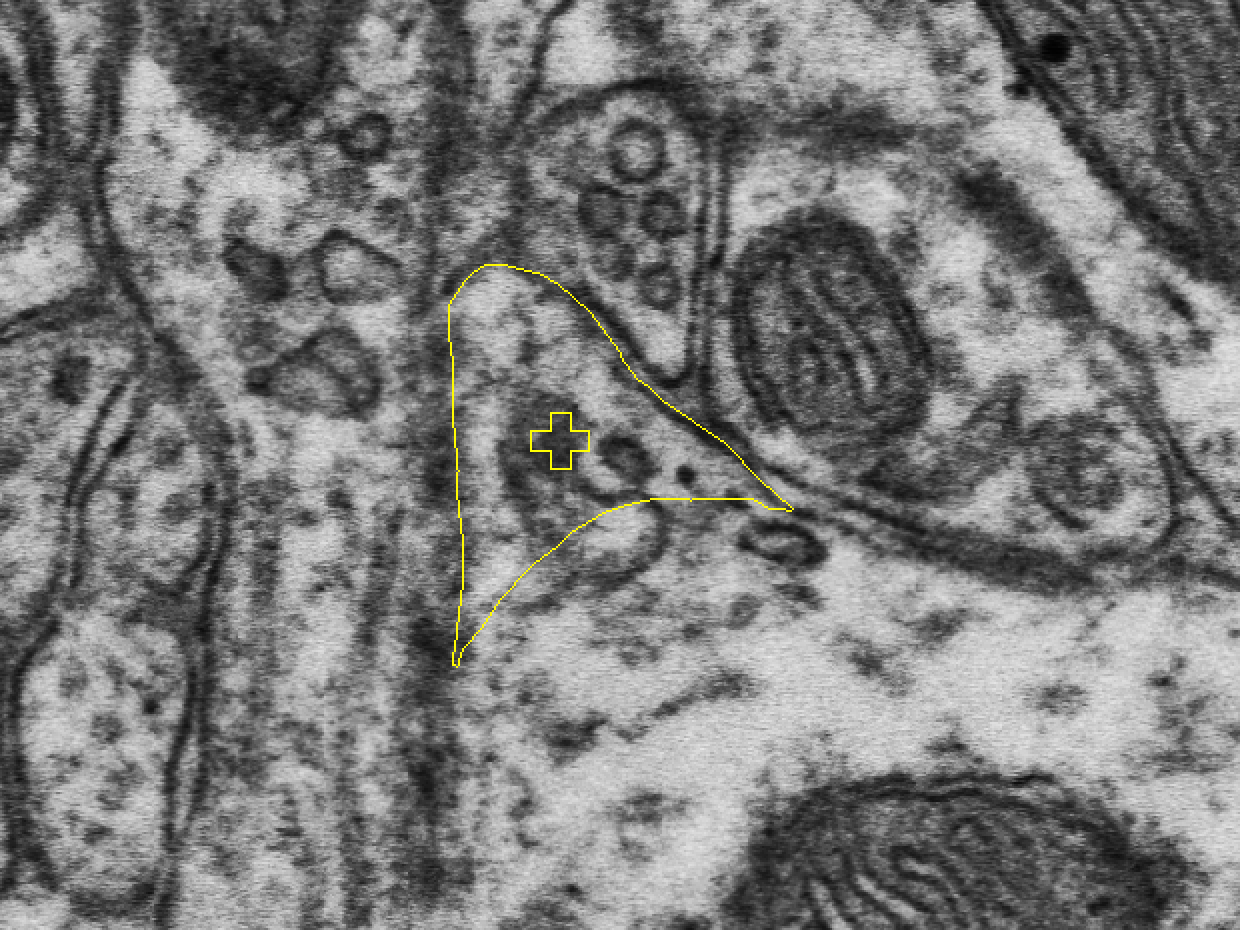
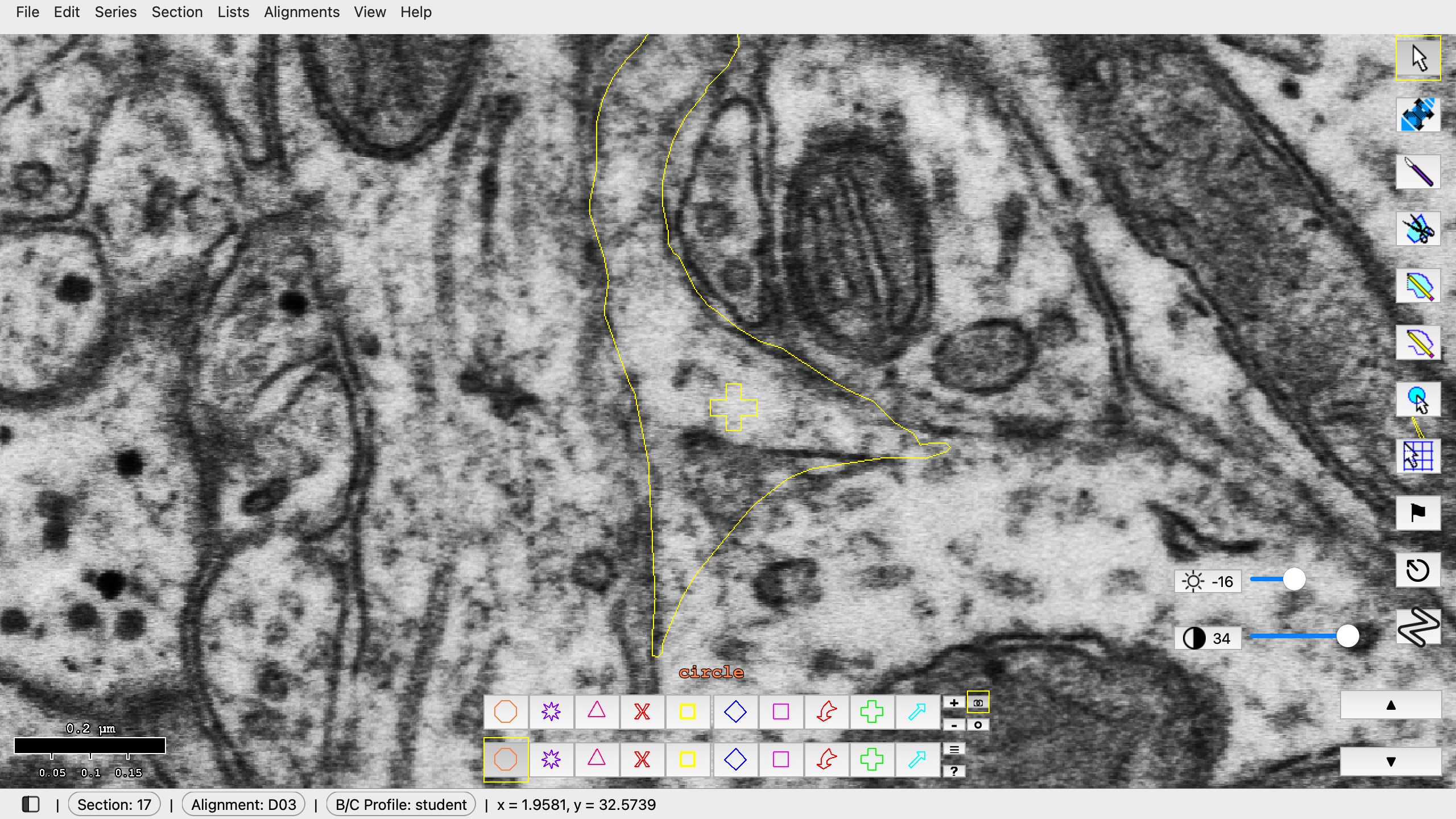
SER in spine d03sp05, sections 13 to 17, stepping up one section at a time.
Spine apparatus (SA)
- The spine apparatus is a specialized derivative of the SER.
- SA is typically seen in large mushroom spines but can also appear in the dendritic shaft.
- SA appears as flat cisternae (arrows) with electron-dense plates between them (wavy arrows); see the figure below.
Figure: spine apparatus, with cisternae (arrows) and dense plates (wavy arrows)
Spacek & Harris, 1997, Fig. 3b. Open the paper.
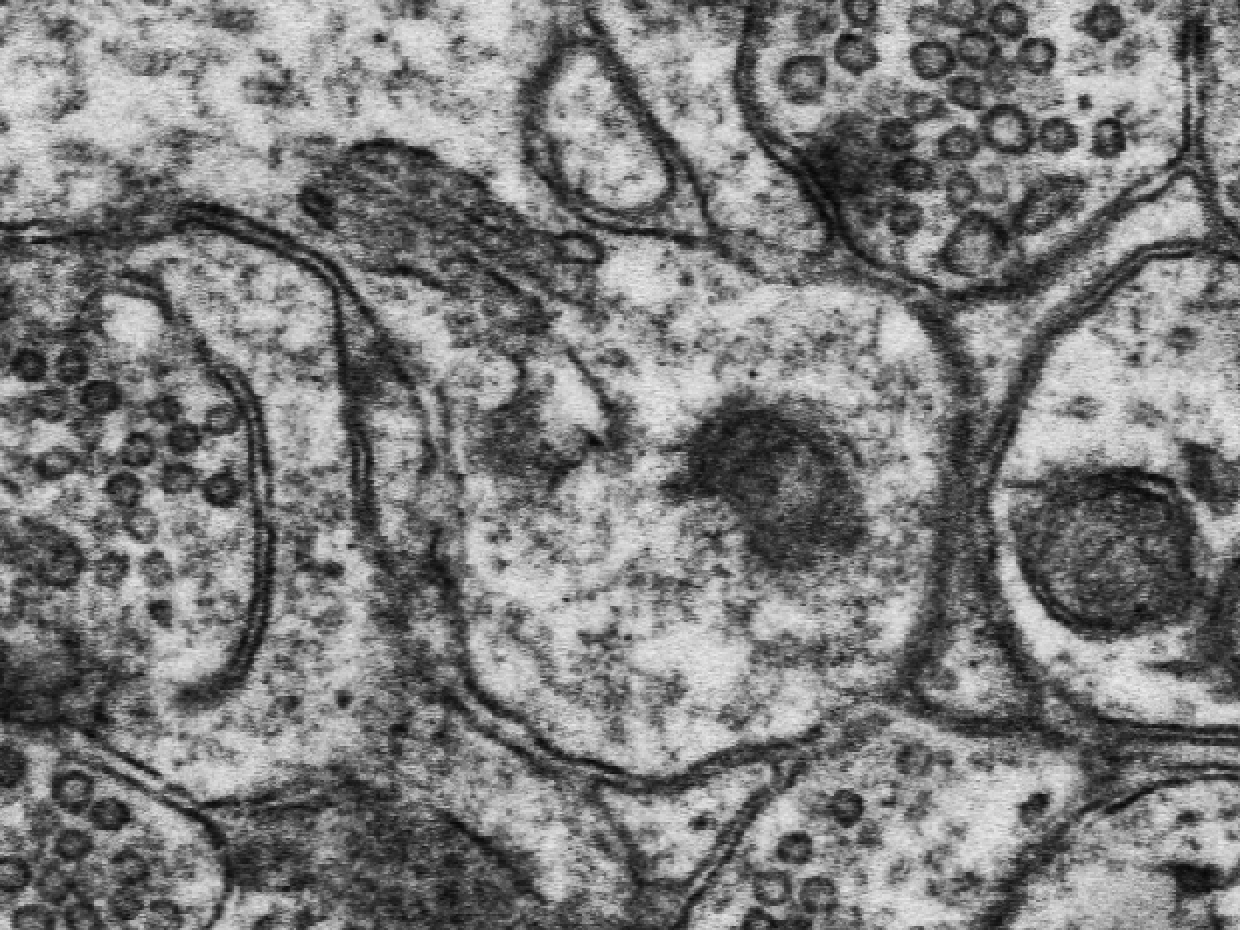
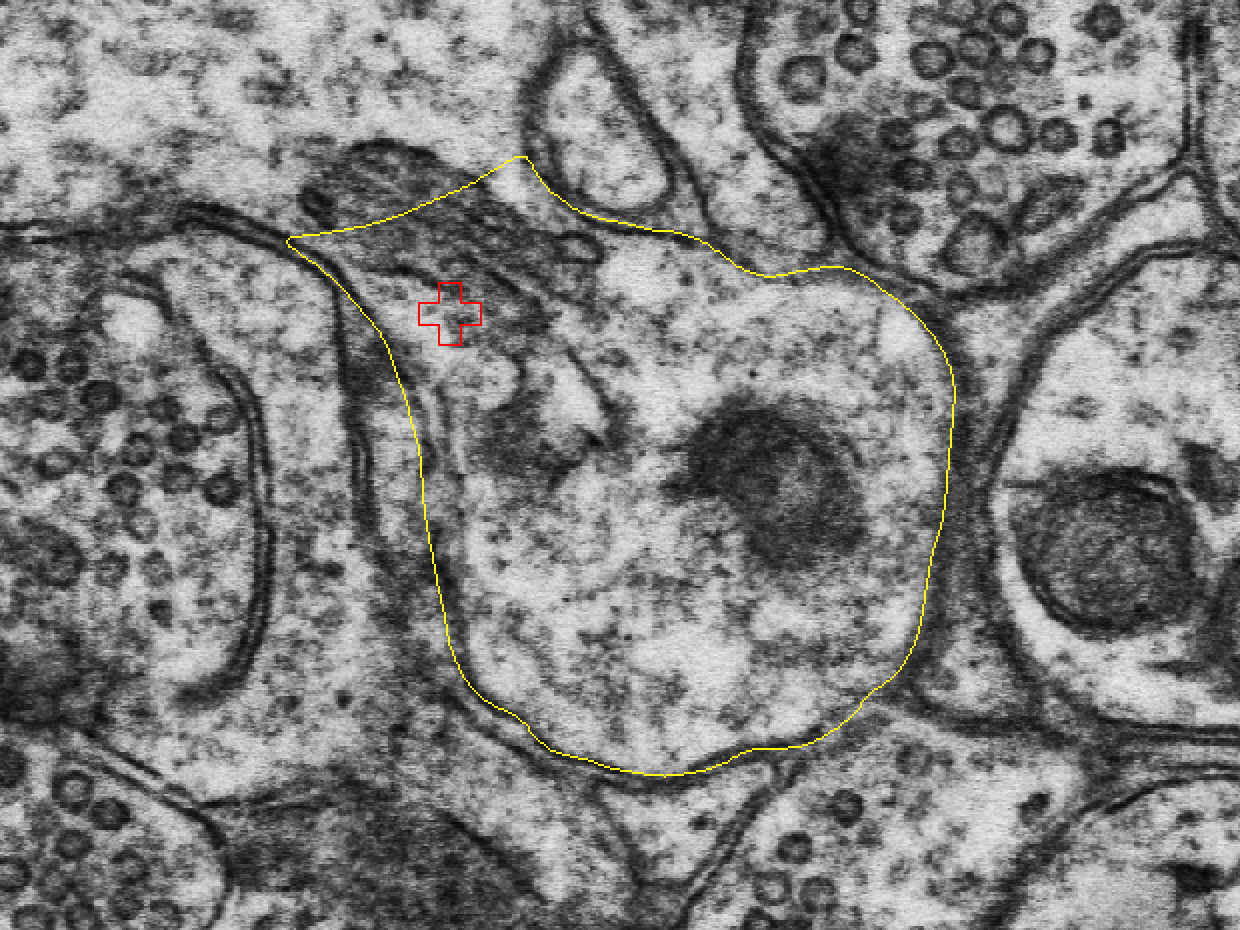
Endosomes
Endosomes are intracellular sorting organelles that are involved with the local recycling, sorting, and degradation of membrane and proteins.
Four major subtypes:
- Multivesicular body
- Tubule
- Smooth vesicle
- Coated vesicle or pit
Figure: drawing of endosome types in three spines
Cooney et al., 2002. Open the paper.
Endosome criteria
1. Coated vesicles/pits
- Vesicles: Elliptical with gray interior and clathrin coat (cytoplasmic coat consisting of spoke-like protrusions).
- Pits: Elliptical, omega-shaped invaginations with gray interiors and clathrin coat.
Figure: clathrin-coated pit, with an inset of a clathrin-coated vesicle
Cooney et al., 2002. Open the paper.
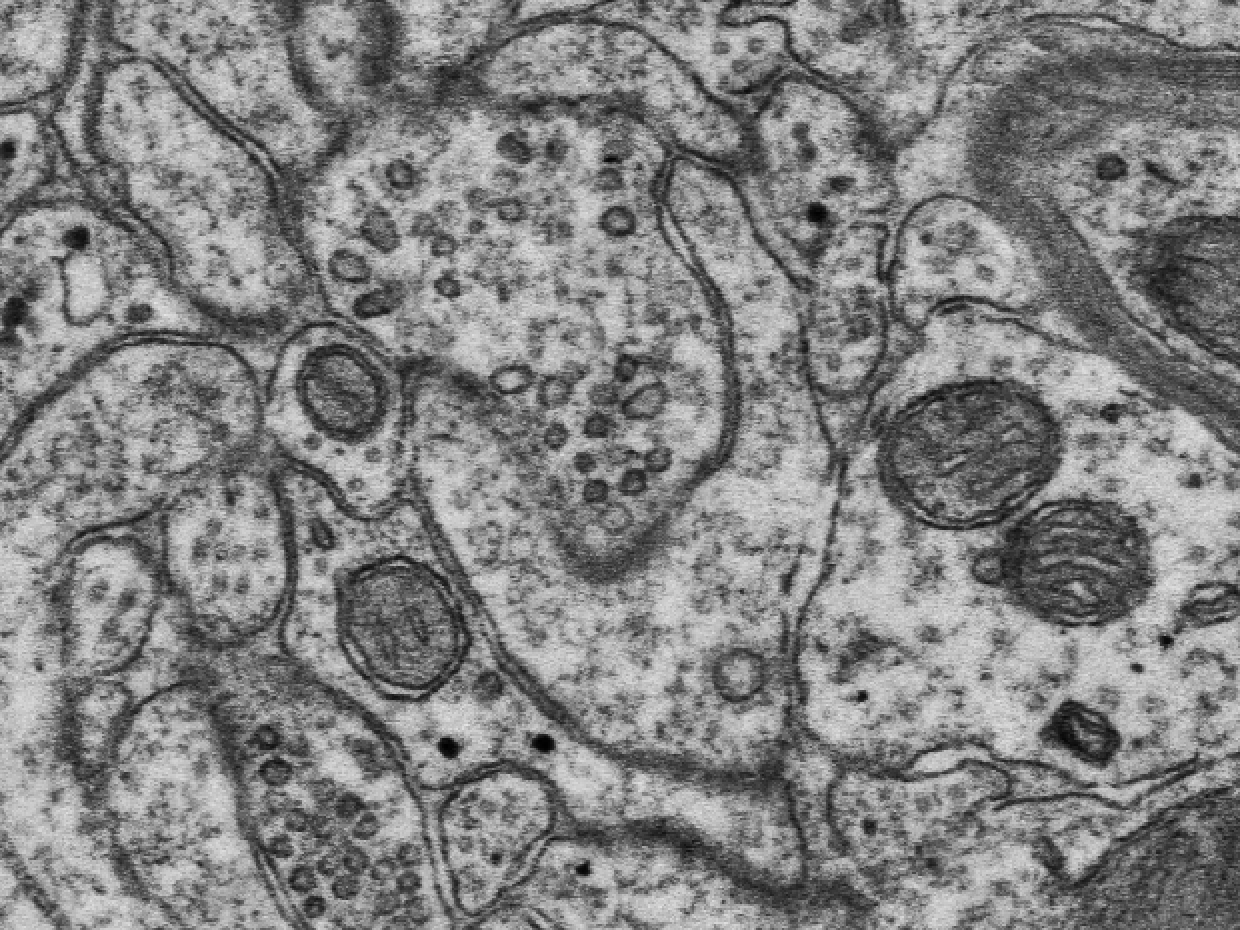
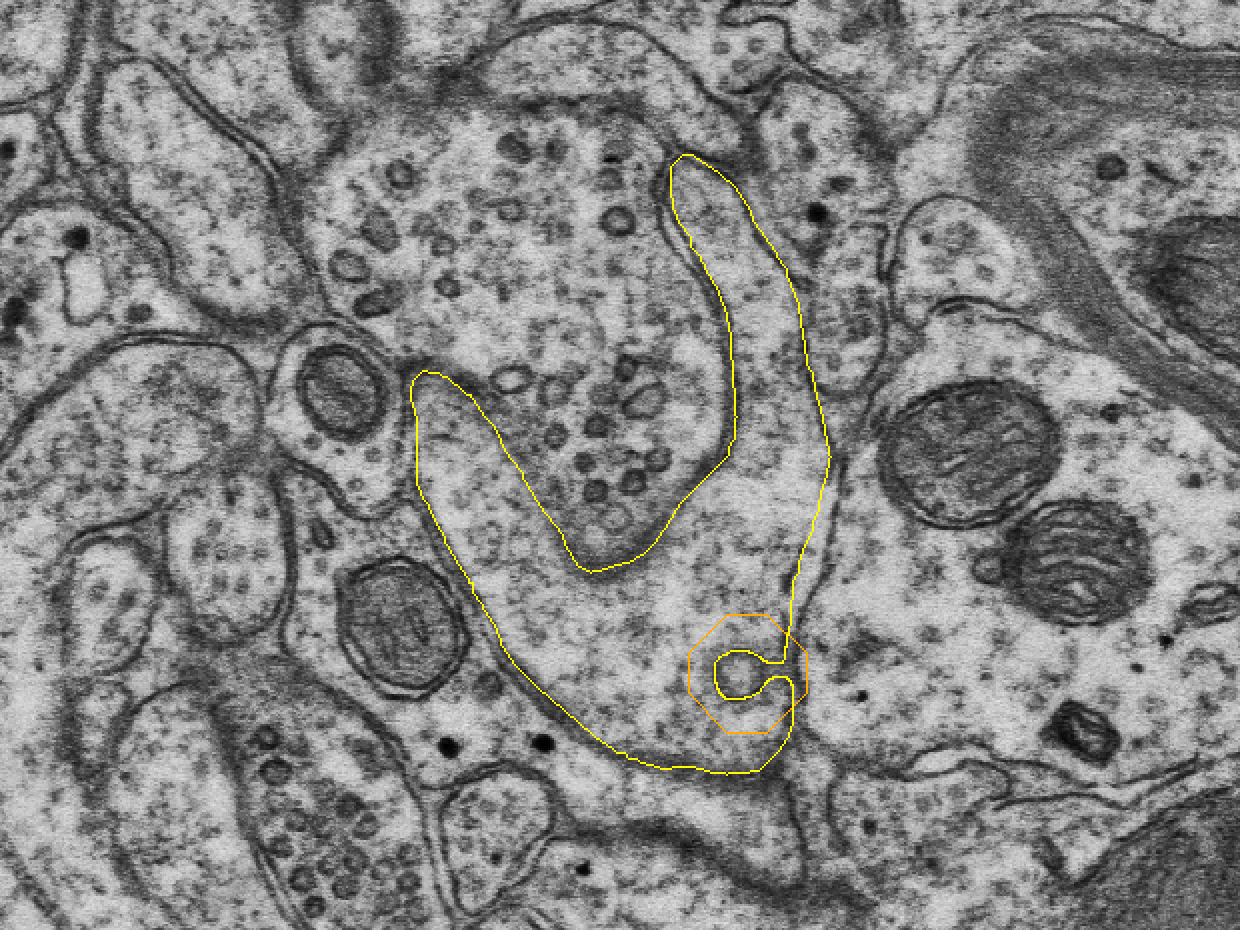
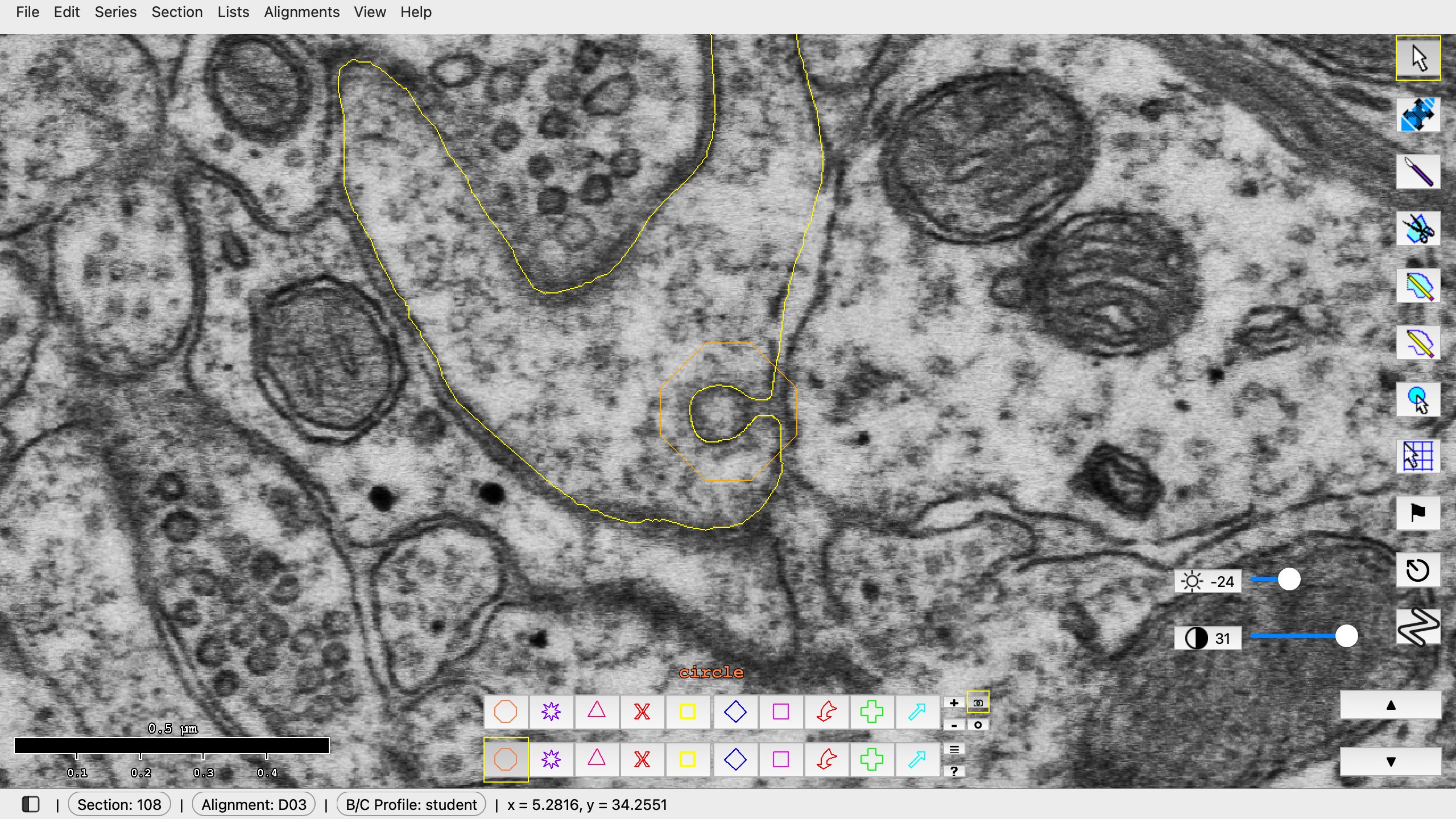
Closing in on the coated pit of spine d03sp29 on section 108.
2. Endosomal tubule
- Cylindrical compartment with smooth outer membrane + dark, grainy interior.
- Uniform diameter.
- May have a clathrin-like protein coat on the end (indicating vesicle budding).
Figure: endosomal tubule
Cooney et al., 2002. Open the paper.
3. Multivesicular body (MVB)
- Dark, grainy interior with variable number of internal vesicles.
Figure: multivesicular body
Cooney et al., 2002. Open the paper.
4. Vesicles (small/large/amorphous)
- Small/large smooth vesicles: light gray interiors with smooth outer membrane.
- Amorphous vesicles: smooth membranes, electron-lucent interiors, and irregular shapes. Often occur in clumps.
Figure: small and large smooth vesicles, and a clump of amorphous vesicles
Cooney et al., 2002. Open the paper.
5 additional spines
To learn to identify these spine resources, you are assigned 5 additional spines:
- d03p12
- d03p14
- d03p37_branched
- d03p40
- d03p42
You will search in these spines for SER, SA, and endosomes. These spines have already been fully traced for you (including their c/cfa-traces).
Stamp spine SER and SA
Identify and stamp SER or SA in each of these 5 spines.
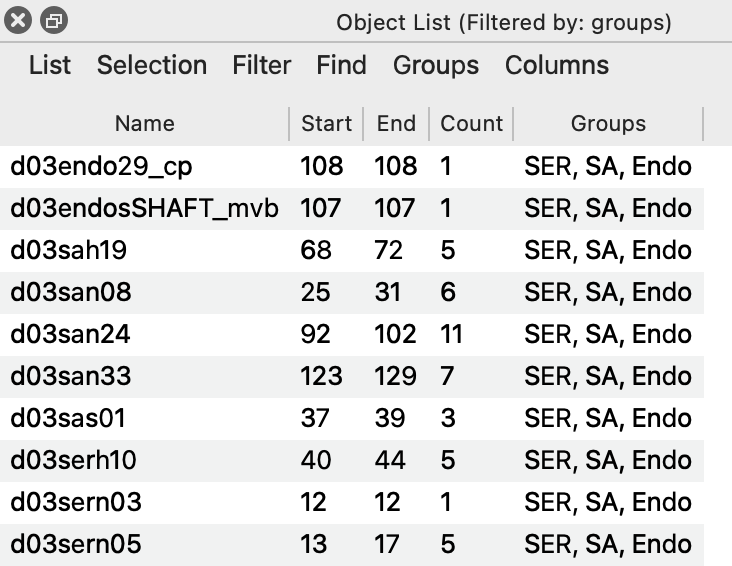
Right-click the palette button to open Set Attributes, set Stamp radius (microns) to 0.05, and set the name to d03sa## for SA and d03ser## for SER, with ## corresponding to the spine ##, e.g., SA found in d03p12 would be named d03sa12. For each of the 5 additional spines listed above, stamp any SER and SA you observe within the spine head and spine neck.
Each of the 5 assigned spines will have either SER or SA.
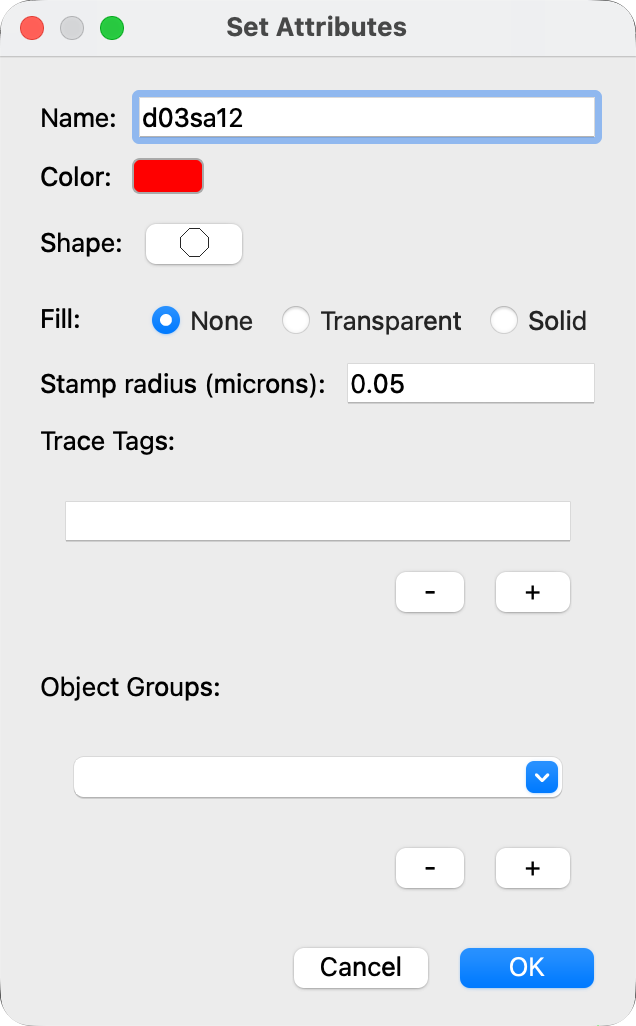
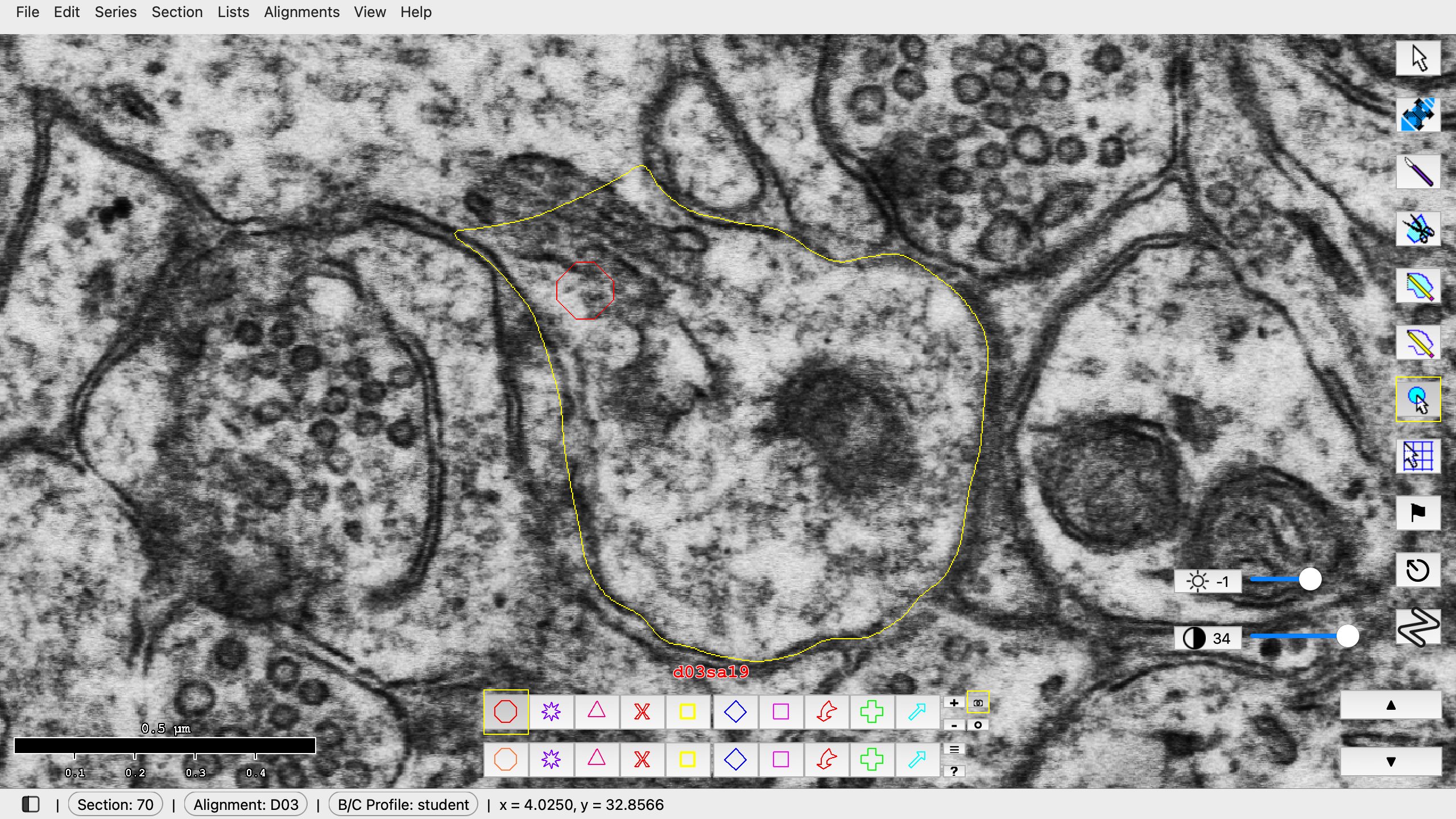
Set the name and the radius, click OK, then click on the SA. Shown in spine d03sp19, not one of your 5 spines.
Stamp spine endosomes
Look for endosomes in each of these 5 spines.
In spines in which endosomes have been identified, place a stamp on the endosomal object.
Hint
You are likely to find a coated pit in these 5 spines. There may be additional endosomal structures that need a second stamp in these spines.
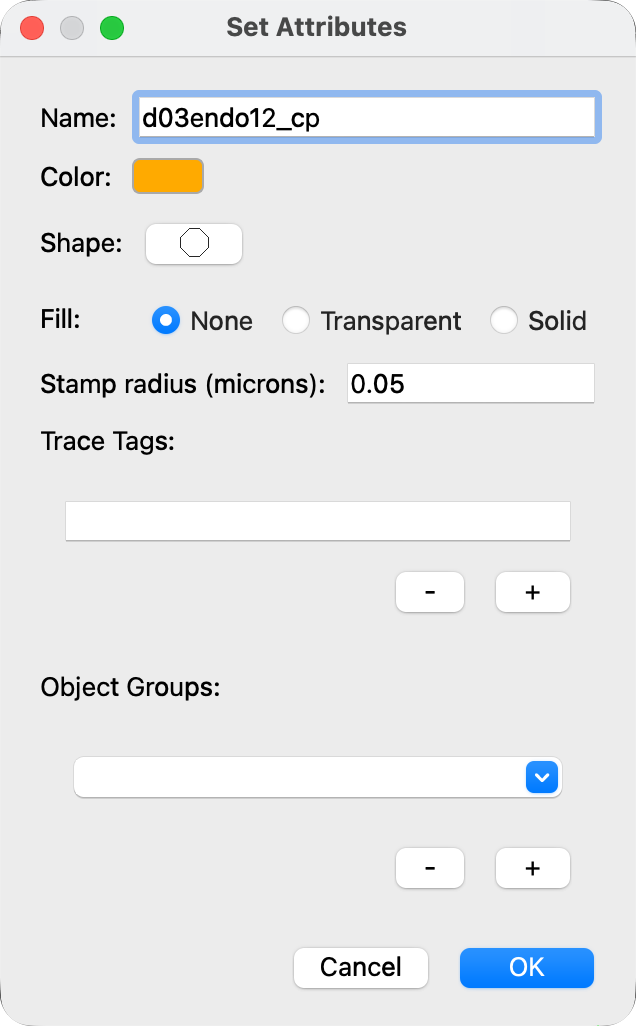
Right-click the palette button to open Set Attributes, set Stamp radius (microns) to 0.05, and set the name to d03endo##_cp (with cp for coated pit and ## corresponding to spine ##). All but one of these spines has at least one endosome.
Extra credit
+0.25 pts extra credit on your lab report if you can correctly identify all coated pits in your spines.
References
- Spacek J, Harris KM (1997). Three-dimensional organization of smooth endoplasmic reticulum in hippocampal CA1 dendrites and dendritic spines of the immature and mature rat. Journal of Neuroscience 17(1):190-203. doi:10.1523/JNEUROSCI.17-01-00190.1997
- Cooney et al. (2002). Journal of Neuroscience 22(6):2215-2224. doi:10.1523/JNEUROSCI.22-06-02215.2002