 KH Lab
Figure Legend Example and Tips
Overview
A figure legend is a brief key that tells the reader what they are looking at. Use this page when you write the legend for each figure you submit (Figures 1 to 5) and for your final lab report.
A good figure legend
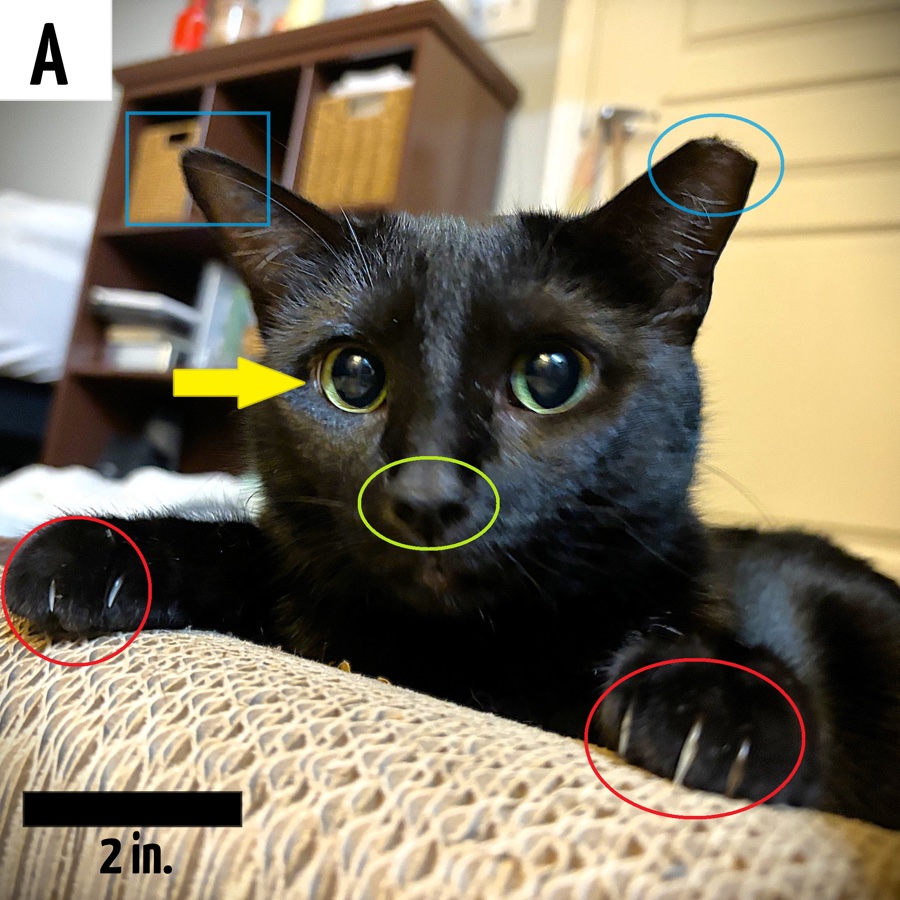
Fig. 1. Black cat rescued from West Campus. A) Digital photograph of black cat with intact ear (blue square), tipped ear (blue circle), watchful eye (yellow arrow), boop snoot (green circle), and murder mittens (red circles). Scale bar = 2 inches. (31 words)
A good legend does these things:
- Descriptive title. The title tells the reader what the figure is about.
- One description per panel. Separate the panels with A), B), C), and so on.
- The medium of the image. Write "EM image" (electron microscopy image), "electron micrograph," or "3D reconstruction," so the reader knows what they are looking at.
- Every structure and its color, in parentheses. For example, "dendritic spines (yellow), synapses (red)." If an arrow or a color points out a structure in the figure, explain it in the legend.
- The size of the scale cube or scale bar.
- The word count, in parentheses at the end of the legend.
- Sentence fragments are fine. You are listing what the reader is looking at, so you do not need a subject and a verb.
- No unnecessary words. Be brief. State precisely what the figure is and nothing more.
A bad figure legend
Fig. 1. Mammal. A) Fig. 1A shows a depiction of an animal with an ear indicated with a blue circle along with a nose and toes.
This legend is bad for these reasons:
- The title is not descriptive. Be more specific. What kind of mammal?
- It wastes words. Do not write "This figure shows...." Start telling the reader what is in the figure. Avoid the word "show" in a legend: a figure always shows things.
- It does not name the medium. Is it a painting, a photograph, or a screenshot from a video game?
- It uses too many words for colors. Put the colors in parentheses. Do not write "indicated with."
- It leaves out colors and shapes. Explain what every color and shape in the image stands for. Here the eye, nose, and toes have none.
- It does not give the scale bar.
- It has no word count.
Legend and Results text are different
The legend and the Results section both report results, but they do different jobs. The legend is a short key. The Results section has more flow, and it never lists colors. See Draft Introduction and Results for an example of each.